


“The OBI fits right into my routine and I can put it on while I'm relaxing.”
– Kassandra, a real SKYRIZI patient
Patients must receive training from their HCP before self-administration and follow the Instructions for Use.
US-MULT-250253

Single-dose SC injector with SKYRIZI prefilled cartridge

Compact Size
Small enough to fit in the palm of the hand

Hands-Free
While adhered to the abdomen or thigh and after activation, patients can do moderate physical activities such as walking, reaching, and bending

Hidden Needle
Discreet injection so patients don’t see the needle
Please see the Instructions for Use to provide patients and/or caregivers proper training on the OBI.
SC=subcutaneous.
REAL-WORLD OBI DATA
In a questionnaire, Crohn’s patients reported their experiences with the OBI at Week 12

LIMITATIONS: The survey data were collected from patients who enrolled in the Skyrizi Complete patient support program, and these patients may have different perceptions of the SKYRIZI OBI vs those who did not enroll. The questions in this analysis were not based on a standardized, validated tool for Crohn’s disease. As-observed data may bias results. There was also potential for recall bias because outcomes were self-reported. Safety and tolerability data were not collected.
ASPIRE-CROHN’S DISEASE STUDY DESIGN: Based on a prospective, longitudinal patient survey of 286 adult patients with moderate to severe Crohn’s disease who had not been treated with SKYRIZI previously and chose to opt in to the study. Surveys were completed at baseline (prior to first SKYRIZI IV infusion) and at Weeks 2, 4, 12, 20, 28, 36, 44, and 52 after initiation of SKYRIZI. Data are from an analysis of patients who had completed surveys at 12 weeks (n=186). Patients reported their experience with the OBI through questions on ease of learning, ease of use, and satisfaction using a 5-point Likert scale that ranged from “very difficult/dissatisfied” to “very easy/satisfied.”
ADMINISTRATION CONSIDERATIONS: SKYRIZI is intended for use under the guidance and supervision of a healthcare professional (HCP). Patients may self-inject SKYRIZI using the on-body injector with prefilled cartridge after training in subcutaneous injection technique. Provide proper training to patients and/or caregivers on the subcutaneous injection technique of SKYRIZI according to the Instructions for Use.1
PATIENT SATISFACTION DATA

~9 out of 10 patients said they were satisfied with the OBI
Route of administration during maintenance satisfaction rates
How satisfied are you with the following route(s) of administration for delivering the maintenance therapy?
Percentage of patients who reported “satisfied” or “highly satisfied”

OBI 8-week maintenance dosing schedule satisfaction rates
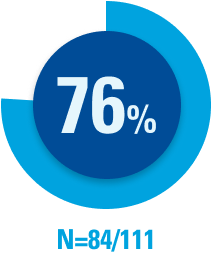
Of those patients with experience using the SKYRIZI OBI, 76% (N=84/111) reported they “strongly agree/agree” that the 8-week maintenance dosing schedule fits better with their routine than a treatment option with a monthly injection schedule.
The approved maintenance dosing for SKYRIZI is every 8 weeks.
Please see SKYRIZI administration considerations. See Instructions for Use for detailed information on administering SKYRIZI OBI.
LIMITATIONS: There are no head-to-head studies comparing routes of administration in IBD so no statistical or clinical conclusions can be drawn. These questions in this interim analysis were not based on a standardized, validated tool for IBD. There was also potential for recall bias because outcomes were self-reported. The data from this questionnaire may not be reflective of all patients who have used these routes of administration for IBD treatment. Efficacy and safety data were not collected.
This survey only included patients who received SKYRIZI maintenance dosing via OBI. This graphic is not intended to compare the efficacy or safety of IBD treatments using these routes of administration. Additional considerations, aside from route of administration, should be taken into account by the HCP and patient before making a treatment decision. Refer to the full Prescribing Information for more details on approved IBD maintenance treatments.
PATIENT QUESTIONNAIRE STUDY DESIGN: Prospective, ongoing patient survey conducted in the US between December 2024 and February 2025 wherein 352 adult patients self-reported outcomes including diagnosis of moderate-to-severe Crohn's or UC at least 1 year prior to taking the survey and use of FDA-approved prescription medication along with the approved route of administration for Crohn's or UC. 102 adult patients on SKYRIZI reported receiving induction (IV) and maintenance (SC) dosing per the Prescribing Information and appropriate training on the OBI from an HCP. Patients were required to either be currently taking or have previously taken maintenance dosing for IBD treatment via at least one of the routes of administration (4 months of treatment with SKYRIZI 180 mg SC or 360 mg SC Q8W or 6 months of treatment with all other medications). Patients reported their experience with the routes of administration in IBD treatment using a 5-point Likert scale that ranged from “not satisfied at all/less satisfied” to “highly satisfied/satisfied.”
IBD=inflammatory bowel disease; IV=intravenous; OBI=on-body injector; Q8W=every 8 weeks; SC=subcutaneous; UC=ulcerative colitis.


“The OBI fits right into my routine and I can put it on while I'm relaxing.”
– Kassandra, a real SKYRIZI patient
Patients must receive training from their HCP before self-administration and follow the Instructions for Use.
SKYRIZI Access
Support for Your Patients and Practice
INDICATIONS AND IMPORTANT SAFETY INFORMATION FOR SKYRIZI® (risankizumab-rzaa)1 Indications Plaque Psoriasis: SKYRIZI is indicated for the treatment of moderate to severe plaque psoriasis in adults and pediatric patients 6 years of age and older who are candidates for systemic therapy or phototherapy. Psoriatic Arthritis: SKYRIZI is indicated for the treatment of active psoriatic arthritis in adults and pediatric patients 6 years of age and older. Crohn's Disease: SKYRIZI is indicated for the treatment of moderately to severely active Crohn's disease in adults. Ulcerative Colitis: SKYRIZI is indicated for the treatment of moderately to severely active ulcerative colitis in adults. |
Important Safety Information
Hypersensitivity Reactions
SKYRIZI® (risankizumab-rzaa) is contraindicated in patients with a history of serious hypersensitivity reaction to risankizumab-rzaa or any of the excipients. Serious hypersensitivity reactions, including anaphylaxis, have been reported with the use of SKYRIZI. If a serious hypersensitivity reaction occurs, discontinue SKYRIZI and initiate appropriate therapy immediately.
Infection
SKYRIZI may increase the risk of infection. Do not initiate treatment with SKYRIZI in patients with a clinically important active infection until it resolves or is adequately treated.
In patients with a chronic infection or a history of recurrent infection, consider the risks and benefits prior to prescribing SKYRIZI. Instruct patients to seek medical advice if signs or symptoms of clinically important infection occur. If a patient develops such an infection or is not responding to standard therapy, closely monitor and discontinue SKYRIZI until the infection resolves.
Tuberculosis (TB)
Consider evaluating patients for TB infection prior to initiating treatment with SKYRIZI based on clinical judgement. Consider anti-TB therapy prior to initiating SKYRIZI in patients with a past history of latent or active TB in whom an adequate course of treatment cannot be confirmed. Monitor patients for signs and symptoms of active TB during and after SKYRIZI treatment. Avoid administering SKYRIZI to patients with active TB.
Hepatotoxicity
Drug-induced liver injury was reported in a patient with Crohn’s disease who was hospitalized for a rash during induction dosing of SKYRIZI. For the treatment of Crohn's disease and ulcerative colitis, evaluate liver enzymes and bilirubin at baseline and during induction (12 weeks); monitor thereafter according to routine patient management. Consider an alternate treatment for patients with evidence of liver cirrhosis. Interrupt treatment if drug-induced liver injury is suspected, until this diagnosis is excluded. Instruct your patient to seek immediate medical attention if they experience symptoms suggestive of hepatic dysfunction.
Immunizations
Avoid use of live vaccines in patients treated with SKYRIZI. Drugs that interact with the immune system may increase the risk of infection following administration of live vaccines. Prior to initiating SKYRIZI, complete all age-appropriate vaccinations according to current immunization guidelines.
Adverse Reactions
Most common (≥1%) adverse reactions associated with SKYRIZI in plaque psoriasis and psoriatic arthritis include upper respiratory infections, headache, fatigue, injection site reactions, and tinea infections.
In psoriatic arthritis phase 3 trials, the incidence of hepatic events was higher with SKYRIZI compared to placebo.
Most common (>3%) adverse reactions associated with SKYRIZI in Crohn’s disease are upper respiratory infections, headache, and arthralgia in induction, and arthralgia, abdominal pain, injection site reactions, anemia, pyrexia, back pain, arthropathy, and urinary tract infection in maintenance.
Most common (≥3%) adverse reactions associated with SKYRIZI in ulcerative colitis are arthralgia in induction, and arthralgia, pyrexia, injection site reactions, and rash in maintenance.
Lipid Elevations: Increases from baseline and increases relative to placebo were observed at Week 4 and remained stable to Week 12 in patients treated with SKYRIZI in Crohn’s disease. Lipid elevations observed in patients with ulcerative colitis were similar to those in Crohn's disease.
Dosage Forms and Strengths: SKYRIZI (risankizumab-rzaa) is available in a 150 mg/mL prefilled syringe and pen, a 55 mg/0.37 mL prefilled syringe, a 600 mg/10 mL single-dose vial for intravenous infusion, and a 180 mg/1.2 mL or 360 mg/2.4 mL single-dose prefilled cartridge with on-body injector.
INDICATIONS
Plaque Psoriasis: SKYRIZI is indicated for the treatment of moderate to severe plaque psoriasis in adults and pediatric patients 6 years of age and older who are candidates for systemic therapy or phototherapy.
Psoriatic Arthritis: SKYRIZI is indicated for the treatment of active psoriatic arthritis in adults and pediatric patients 6 years of age and older.
Crohn's Disease: SKYRIZI is indicated for the treatment of moderately to severely active Crohn's disease in adults.
Ulcerative Colitis: SKYRIZI is indicated for the treatment of moderately to severely active ulcerative colitis in adults.
Please see Full Prescribing Information.
US-SKZ-260294
REFERENCES