WEEK 16
HIGH IMPACT AREAS SCALP, GENITAL, PALMOPLANTAR, AND NAIL PSORIASIS
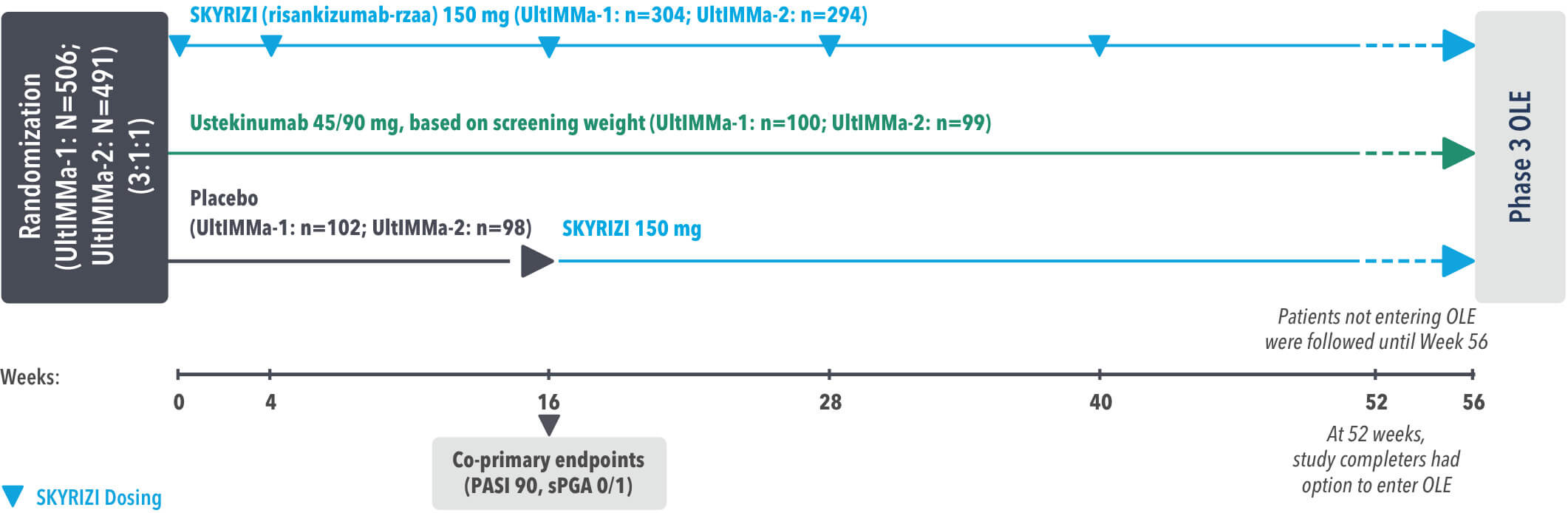
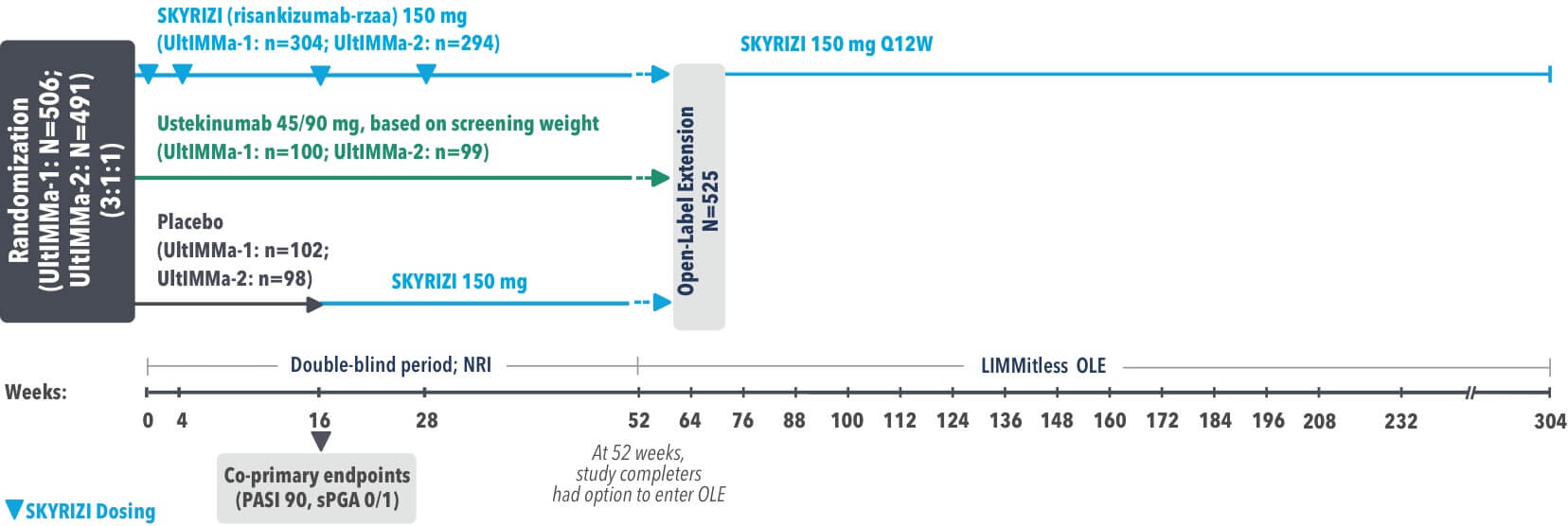
CO-PRIMARY ENDPOINTS IN UltIMMa-1 AND UltIMMa-2 (NRI)1,2
PASI 90 at Week 16
UltIMMa-1:
SKYRIZI 75% (229/304), placebo 5% (5/102)
UltIMMa-2:
SKYRIZI 75% (220/294), placebo 2% (2/98)
p<0.0001.
sPGA 0/1 at Week 16
UltIMMa-1:
SKYRIZI 88% (267/304), placebo 8% (8/102)
UltIMMa-2:
SKYRIZI 84% (246/294), placebo 5% (5/98)
NRI=Non-responder imputation.
STUDY DESIGN:
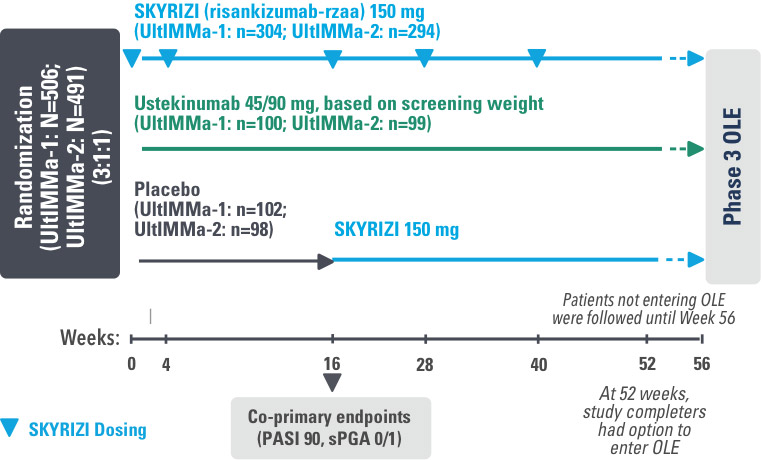
UltIMMa-1 (N=506) and UltIMMa-2 (N=491) were replicate Phase 3, randomized, double-blind, placebo- and active-controlled studies to evaluate the efficacy and safety of SKYRIZI (150 mg) vs placebo over 16 weeks and biologic active control (45 mg or 90 mg, based on screening weight) over 52 weeks in adult patients with moderate to severe plaque psoriasis. Patients received SKYRIZI 150 mg at Week 0, Week 4, and every 12 weeks thereafter.1,2
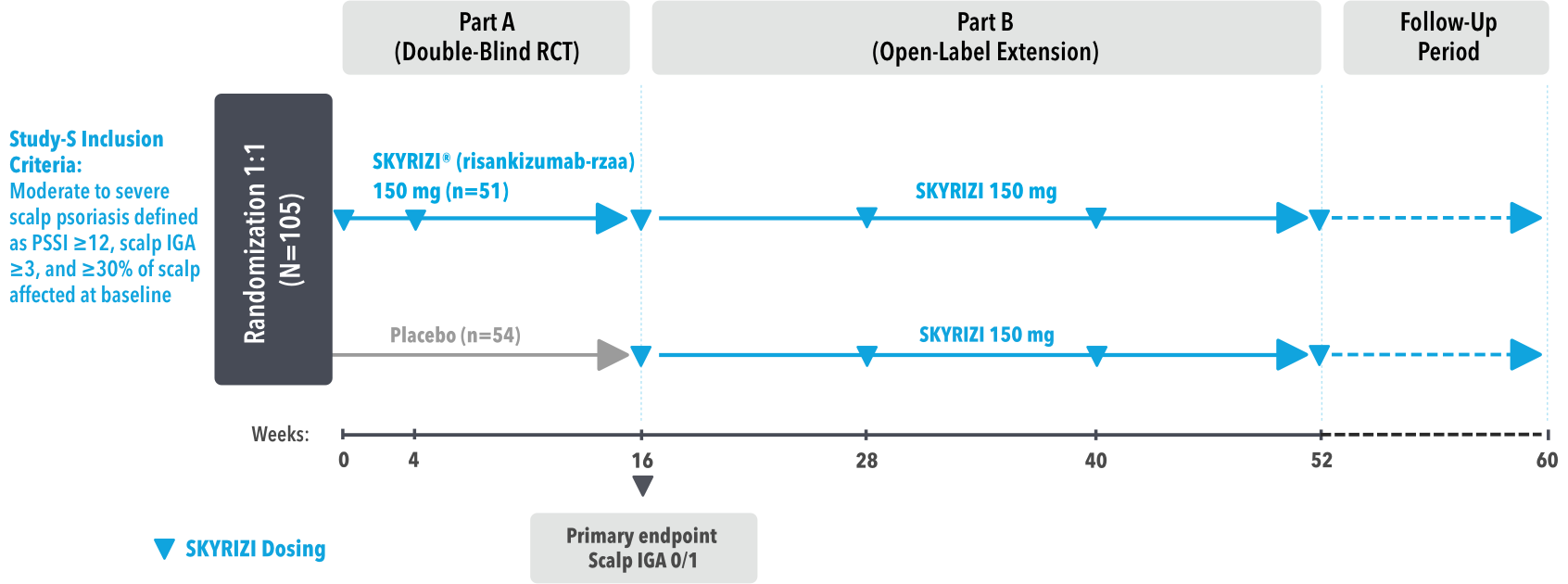
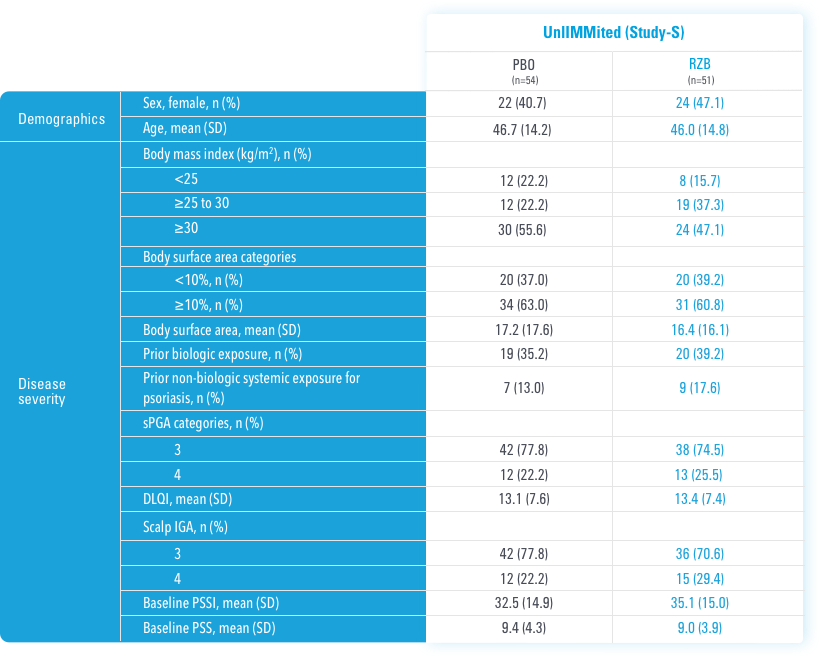
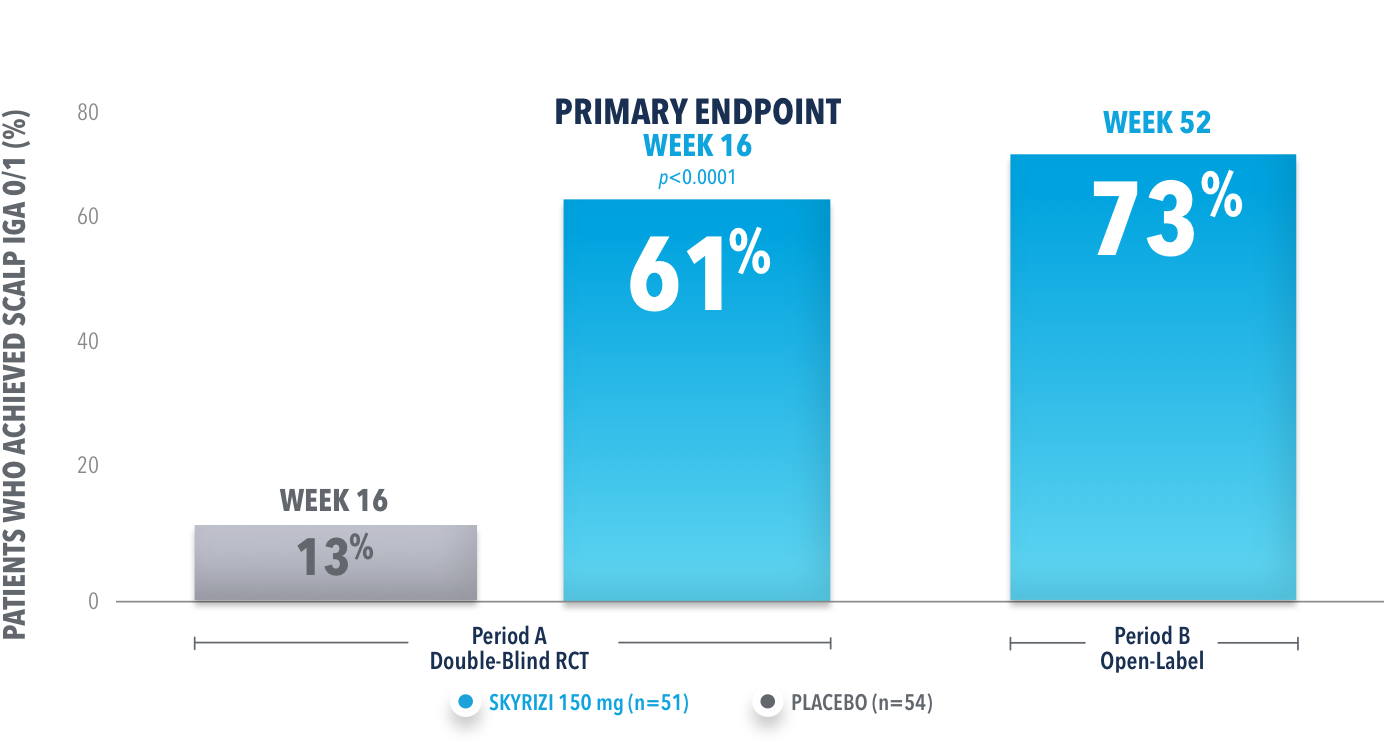
In UnlIMMited (Study-S), a phase 4, multicenter, randomized, double-blind, placebo-controlled study evaluating SKYRIZI in adult patients with moderate to severe scalp psoriasis
DURABLE RESPONSE RATES IN SCALP3,4
73% OF PATIENTS ACHIEVED CLEAR OR ALMOST CLEAR SCALP (NRI) AT 1 YEAR (OL)3,4
LIMITATION:
Achievement of scalp IGA 0 or 1 at Week 52 was a prespecified, nonranked endpoint and not adjusted for multiplicity. Therefore, treatment differences cannot be regarded as statistically significant.
OPEN-LABEL (OL) LIMITATIONS:
In an open-label study or period, there is potential for enrichment; awareness of active treatment may cause bias to overall treatment effect.
The scalp IGA is a 5-point scale ranging from 0 (clear) to 4 (severe) incorporating an assessment of the severity of the 3 primary signs of the disease: erythema, scaling, and plaque elevation.
STUDY DESIGN:
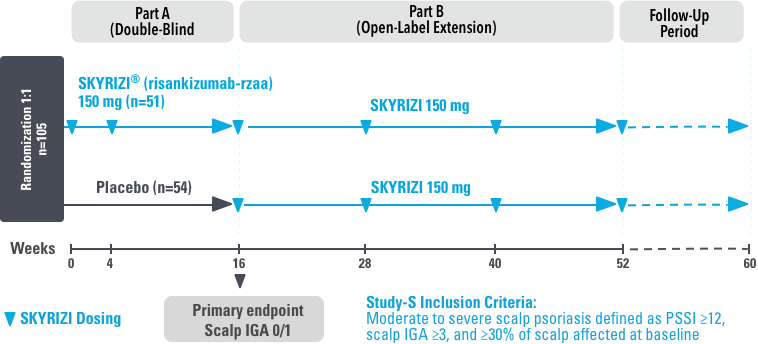
UnlIMMited is a Phase 4, multicenter, randomized, double-blind, placebo-controlled basket study examining the effect of SKYRIZI (150 mg) vs placebo in adult patients with moderate to severe scalp psoriasis (Study-S). Patients were randomized in a ratio of 1:1 to receive SKYRIZI or placebo. Beginning at Week 16, all patients received open-label SKYRIZI (150 mg) every 12 weeks with the last dose occurring at Week 40. Subjects had the option to continue treatment with open-label SKYRIZI (150 mg) if they completed the study through Week 52.
NRI=nonresponder imputation; OL=open-label; RCT=randomized controlled trial; scalp IGA=scalp Investigator's Global Assessment.
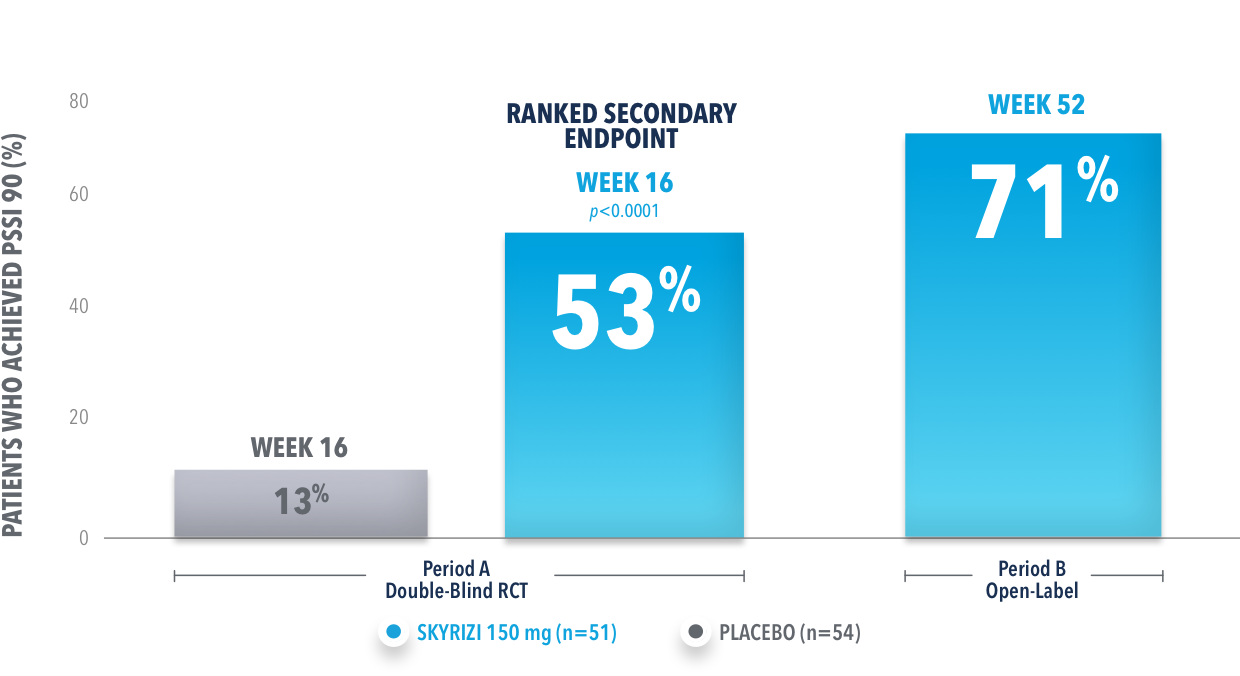
In UnlIMMited (Study-S), a phase 4, multicenter, randomized, double-blind, placebo-controlled study evaluating SKYRIZI in adult patients with moderate to severe scalp psoriasis
90% CLEARER SCALP3,4
MAJORITY OF PATIENTS ACHIEVED PSSI 90 (NRI) AT 1 YEAR (OL)3,4
LIMITATIONS:
Achievement of PSSI 90 at Week 52 was a prespecified, nonranked endpoint and not adjusted for multiplicity. Therefore, treatment differences cannot be regarded as statistically significant.
OPEN-LABEL (OL) LIMITATIONS:
In an open-label study or period, there is potential for enrichment; awareness of active treatment may cause bias to overall treatment effect.
The composite PSSI score is calculated as the sum of the scores for erythema, induration, and desquamation multiplied by the score recorded for the extent of scalp area involved. The PSSI ranges from 0 to 72.
STUDY DESIGN:
UnllMMited is a Phase 4, multicenter, randomized, double-blind, placebo-controlled basket study examining the effect of SKYRIZI (150 mg) vs placebo in adult patients with moderate to severe scalp psoriasis (Study-S). Patients were randomized in a ratio of 1:1 to receive SKYRIZI or placebo up to Week 16. Beginning at Week 16, all patients received open-label SKYRIZI (150 mg) every 12 weeks with the last dose occurring at Week 40.
NRI=nonresponder imputation; OL=open-label; PSSI=Psoriasis Scalp Severity Index.
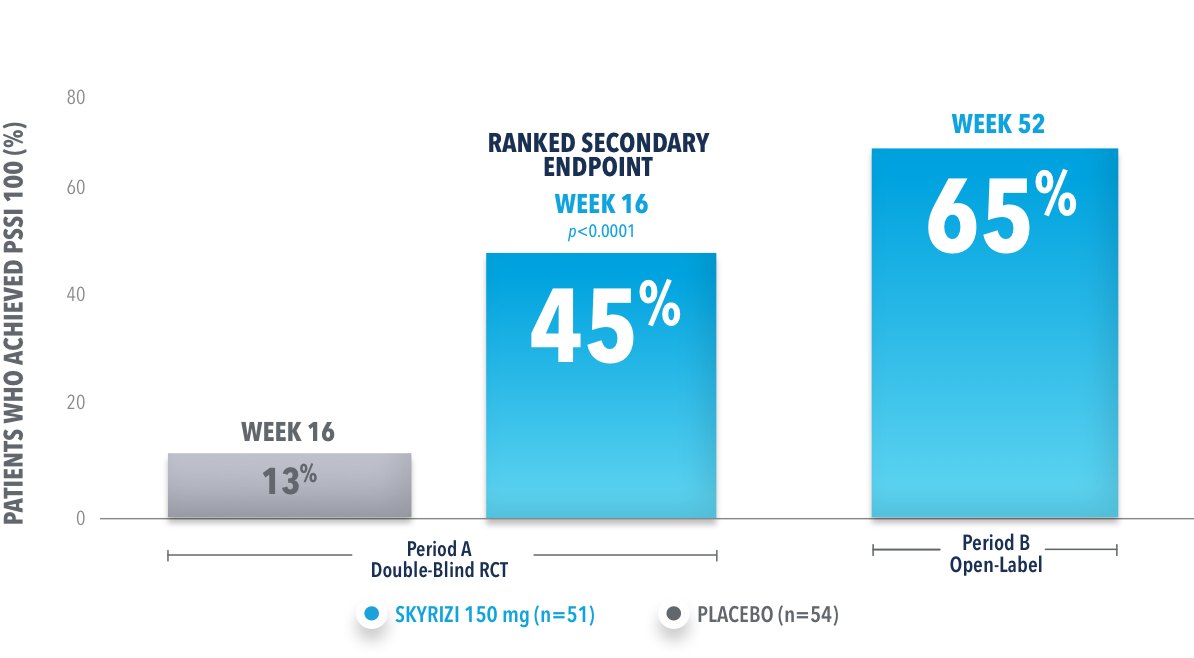
In UnlIMMited (Study-S), a phase 4, multicenter, randomized, double-blind, placebo-controlled study evaluating SKYRIZI in adult patients with moderate to severe scalp psoriasis
100% PLAQUE-FREE SCALP3,4
MAJORITY OF PATIENTS ACHIEVED PSSI 100 (NRI) AT 1 YEAR (OL)3,4
LIMITATIONS:
Achievement of PSSI 100 at Week 52 was a prespecified, nonranked endpoint and not adjusted for multiplicity. Therefore, treatment differences cannot be regarded as statistically significant.
OPEN-LABEL (OL) LIMITATIONS:
In an open-label study or period, there is potential for enrichment; awareness of active treatment may cause bias to overall treatment effect.
The composite PSSI score is calculated as the sum of the scores for erythema, induration, and desquamation multiplied by the score recorded for the extent of scalp area involved. The PSSI ranges from 0 to 72.
STUDY DESIGN:
UnlIMMited is a Phase 4, multicenter, randomized, double-blind, placebo-controlled basket study examining the effect of SKYRIZI (150 mg) vs placebo in adult patients with moderate to severe scalp psoriasis (Study-S). Patients were randomized in a ratio of 1:1 to receive SKYRIZI or placebo up to Week 16. Beginning at Week 16, all patients received open-label SKYRIZI (150 mg) every 12 weeks with the last dose occurring at Week 40.
NRI=nonresponder imputation; OL=open-label; PSSI=Psoriasis Scalp Severity Index.
In UnlIMMited (Study-S), a phase 4, multicenter, randomized, double-blind, placebo-controlled study evaluating SKYRIZI in adult patients with moderate to severe scalp psoriasis
ITCH DATA IN SCALP PSORIASIS3,8
68% OF PATIENTS REPORTED A 4-POINT OR GREATER REDUCTION
OF SCALP ITCH NRS (NRI) AT 1 YEAR (OL)3,8*
*AMONG PATIENTS WITH A BASELINE SCORE OF ≥4
SKYRIZI 150 mg
PLACEBO 11% (n=54)
WEEK 52
ITCH NRS AT BASELINE (SD)
LIMITATIONS:
Achievement of ≥4-point improvement (reduction) from baseline on the Scalp Itch NRS among subjects with a baseline score ≥4 was a prespecified, nonranked endpoint and not controlled for multiplicity. Therefore, treatment differences cannot be regarded as statistically significant.
The Scalp Psoriasis Itch Numerical Rating Scale (Scalp Ps-ltch NRS) is a patient-reported instrument that assesses itch on a scale of O (no itch) to 10 (worst imaginable itch).
OPEN-LABEL (OL) LIMITATIONS:
In an open-label study or period, there is potential for enrichment; awareness of active treatment may cause bias to overall treatment effect.
STUDY DESIGN:
UnllMMited is a Phase 4, multicenter, randomized, double-blind, placebo-controlled basket study examining the effect of SKYRIZI (150 mg) vs placebo in adult patients with moderate to severe scalp psoriasis (Study-S). Patients were randomized in a ratio of 1:1 to receive SKYRIZI or placebo up to Week 16. Beginning at Week 16, all patients received open-label SKYRIZI (150 mg) every 12 weeks with the last dose occurring at Week 40.
NRI=nonresponder imputation; OL=open-label; Scalp Ps-Itch NRS=Scalp Psoriasis Itch Numerical Rating Scale; SD=standard deviation.
In UnlIMMited (Study-S), a phase 4, multicenter, randomized, double-blind, placebo-controlled study evaluating SKYRIZI in adult patients with moderate to severe scalp psoriasis
DLQI DATA IN SCALP PSORIASIS3,8
65% OF PATIENTS REPORTED DLQI 0/1 (NRI) AT 1 YEAR (OL)3,8
WEEK 16
SKYRIZI 150 mg
PLACEBO 11% (n=54)
WEEK 52
LIMITATIONS:
Achievement of DLQI of 0 or 1 was a prespecified, nonranked endpoint and not controlled for multiplicity. Therefore, treatment differences cannot be regarded as statistically significant.
OPEN-LABEL (OL) LIMITATIONS:
In an open-label study or period, there is potential for enrichment; awareness of active treatment may cause bias to overall treatment effect.
STUDY DESIGN:
UnllMMited is a Phase 4, multicenter, randomized, double-blind, placebo-controlled basket study examining the effect of SKYRIZI (150 mg) vs placebo in adult patients with moderate to severe scalp psoriasis (Study-S). Patients were randomized in a ratio of 1:1 to receive SKYRIZI or placebo up to Week 16. Beginning at Week 16, all patients received open-label SKYRIZI (150 mg) every 12 weeks with the last dose occurring at Week 40.
DLQI=Dermatology Life Quality Index; NRI=nonresponder imputation; OL=open-label; SD=standard deviation.
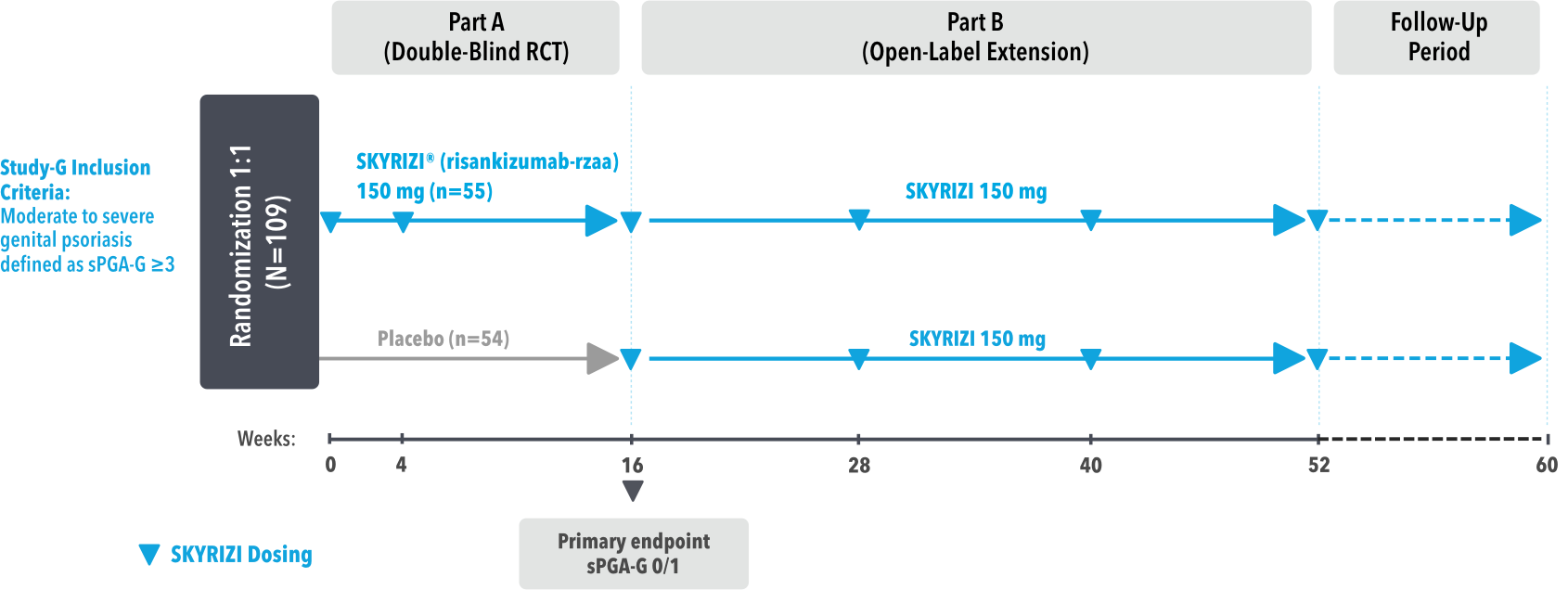
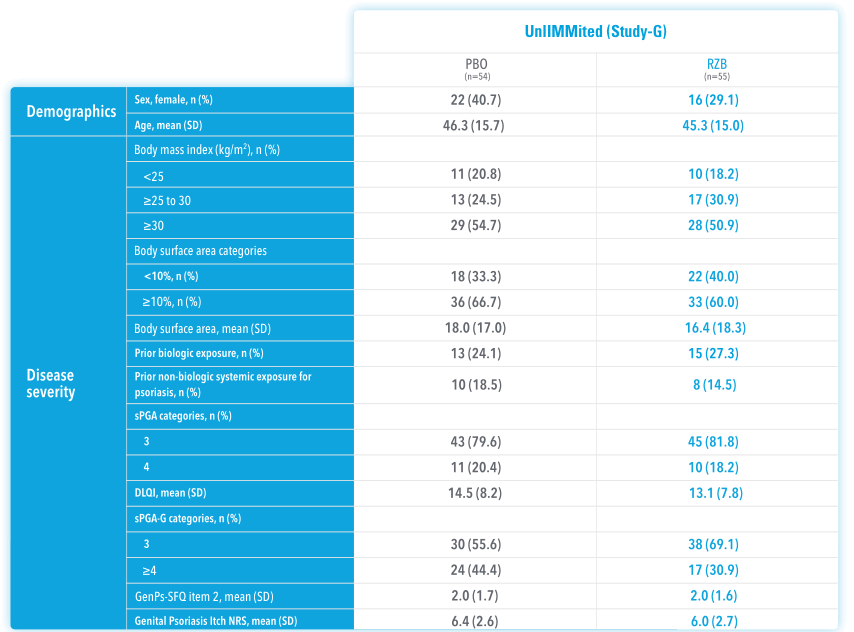
In UnlIMMited (Study-G), a phase 4, multicenter, randomized, double-blind, placebo-controlled study evaluating SKYRIZI in adult patients with moderate to severe genital psoriasis
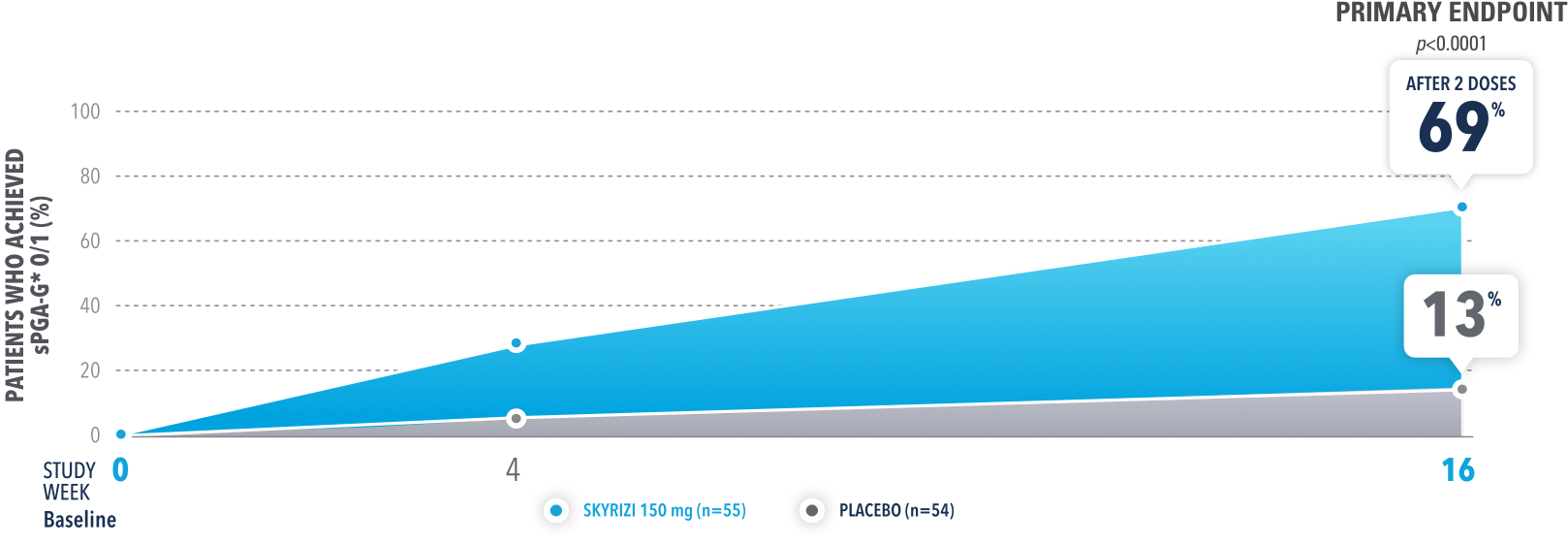
DURABLE RESPONSE RATES IN GENITAL AREA3,4
82% OF PATIENTS ACHIEVED COMPLETELY CLEAR OR ALMOST CLEAR SKIN IN GENITAL AREA (NRI) AT 1 YEAR (OL)3,4
LIMITATIONS:
Achievement of sPGA-G of O or 1 at Week 4 and Week 52 were prespecified, nonranked endpoints and not adjusted for multiplicity. Therefore, treatment differences cannot be regarded as statistically significant.
OPEN-LABEL (OL) LIMITATIONS:
In an open-label study or period, there is potential for enrichment; awareness of active treatment may cause bias to overall treatment effect.
The sPGA-G is a 6-point scale based on the extent of erythema, plaque elevation, and/or scale. It ranges from O (clear) to 5 (very severe).
STUDY DESIGN:
UnllMMited is a Phase 4, multicenter, randomized, double-blind, placebo-controlled basket study examining the effect of SKYRIZI (150 mg) vs placebo in adult patients with moderate to severe genital psoriasis (Study-G). Patients were randomized in a ratio of 1:1 to receive SKYRIZI or placebo. Beginning at Week 16, all patients received open-label SKYRIZI (150 mg) every 12 weeks with the last dose occurring at Week 40.
NRI=nonresponder imputation; OL=open-label; *sPGA-G=static Physician's Global Assessment of Genitalia.
In UnlIMMited (Study-G), a phase 4, multicenter, randomized, double-blind, placebo-controlled study evaluating SKYRIZI in adult patients with moderate to severe genital psoriasis
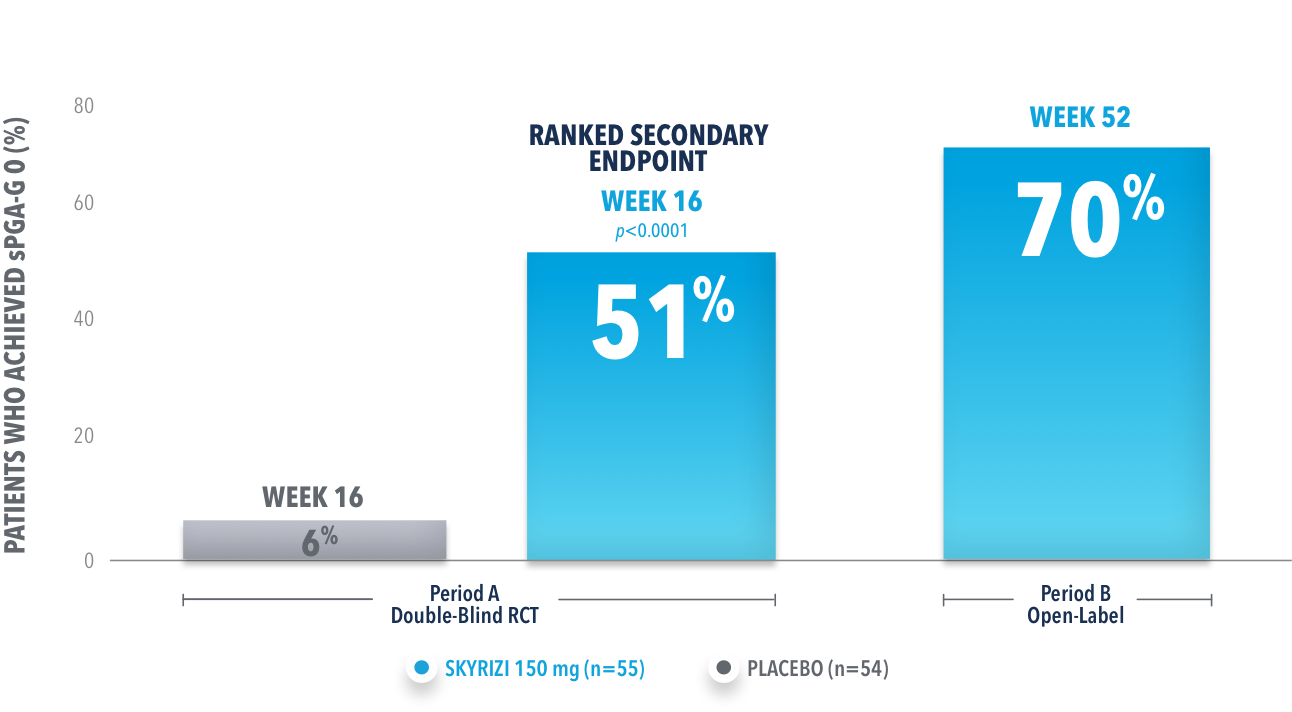
100% PLAQUE-FREE GENITAL AREA3,4
MAJORITY OF PATIENTS ACHIEVED COMPLETE CLEARANCE
OF THEIR GENITAL PSORIASIS (NRI) AT 1 YEAR (OL)3,4
LIMITATIONS:
Achievement of sPGA-G of 0 at Week 52 was a prespecified, nonranked endpoint and not adjusted for multiplicity. Therefore, treatment differences cannot be regarded as statistically significant.
OPEN-LABEL (OL) LIMITATIONS:
In an open-label study or period, there is potential for enrichment; awareness of active treatment may cause bias to overall treatment effect.
The sPGA-G is a 6-point scale ranging from 0 to 5. The final sPGA-G score should be based on a combination of erythema and the secondary features (plaque elevation and/or scale).
STUDY DESIGN:
UnllMMited is a Phase 4, multicenter, randomized, double-blind, placebo-controlled basket study examining the effect of SKYRIZI (150 mg) vs placebo in adult patients with moderate to severe genital psoriasis (Study-G). Patients were randomized in a ratio of 1:1 to receive SKYRIZI or placebo up to Week 16. Beginning at Week 16, all patients received open-label SKYRIZI (150 mg) every 12 weeks with the last dose occurring at Week 40.
NRI=nonresponder imputation; OL=open-label; sPGA-G=static Physician's Global Assessment of Genitalia.
In UnlIMMited (Study-G), a phase 4, multicenter, randomized, double-blind, placebo-controlled study evaluating SKYRIZI in adult patients with moderate to severe genital psoriasis
ITCH DATA IN GENITAL PSORIASIS3,4
81% OF PATIENTS REPORTED A CLINICALLY MEANINGFUL IMPROVEMENT OF GENITAL PSORIASIS ITCH NRS (NRI) AT 1 YEAR (OL)3,4*
*AMONG PATIENTS WITH A BASELINE SCORE OF ≥4
WEEK 16
RANKED SECONDARY ENDPOINT
p<0.0001
SKYRIZI 150 mg
PLACEBO 7% (n=54)
WEEK 52
ITCH NRS AT BASELINE (SD)
LIMITATIONS:
Achievement of ≥4-point improvement (reduction) from baseline on the Genital Itch NRS among subjects with a baseline score ≥4 at Week 52 was a prespecified, nonranked endpoint and not adjusted for multiplicity. Therefore, treatment differences cannot be regarded as statistically significant.
OPEN-LABEL (OL) LIMITATIONS:
In an open-label study or period, there is potential for enrichment; awareness of active treatment may cause bias to overall treatment effect.
The Genital Psoriasis Itch Numerical Rating Scale (GenPs-Itch NRS) is a patient-reported instrument that assesses itch on a scale of 0 (no itch) to 10 (worst imaginable itch).
STUDY DESIGN:
UnllMMited is a Phase 4, multicenter, randomized, double-blind, placebo-controlled basket study examining the effect of SKYRIZI (150 mg) vs placebo in adult patients with moderate to severe genital psoriasis (Study-G). Patients were randomized in a ratio of 1:1 to receive SKYRIZI or placebo up to Week 16. Beginning at Week 16, all patients received open-label SKYRIZI (150 mg) every 12 weeks with the last dose occurring at Week 40.
GenPs-Itch NRS=Genital Psoriasis Itch Numerical Rating Scale; NRI=nonresponder imputation; OL=open-label; SD=standard deviation.
IMMprint, a randomized, double-blind, placebo-controlled, Phase 3b study evaluating SKYRIZI in adult patients with moderate to severe psoriasis with palmoplantar involvement
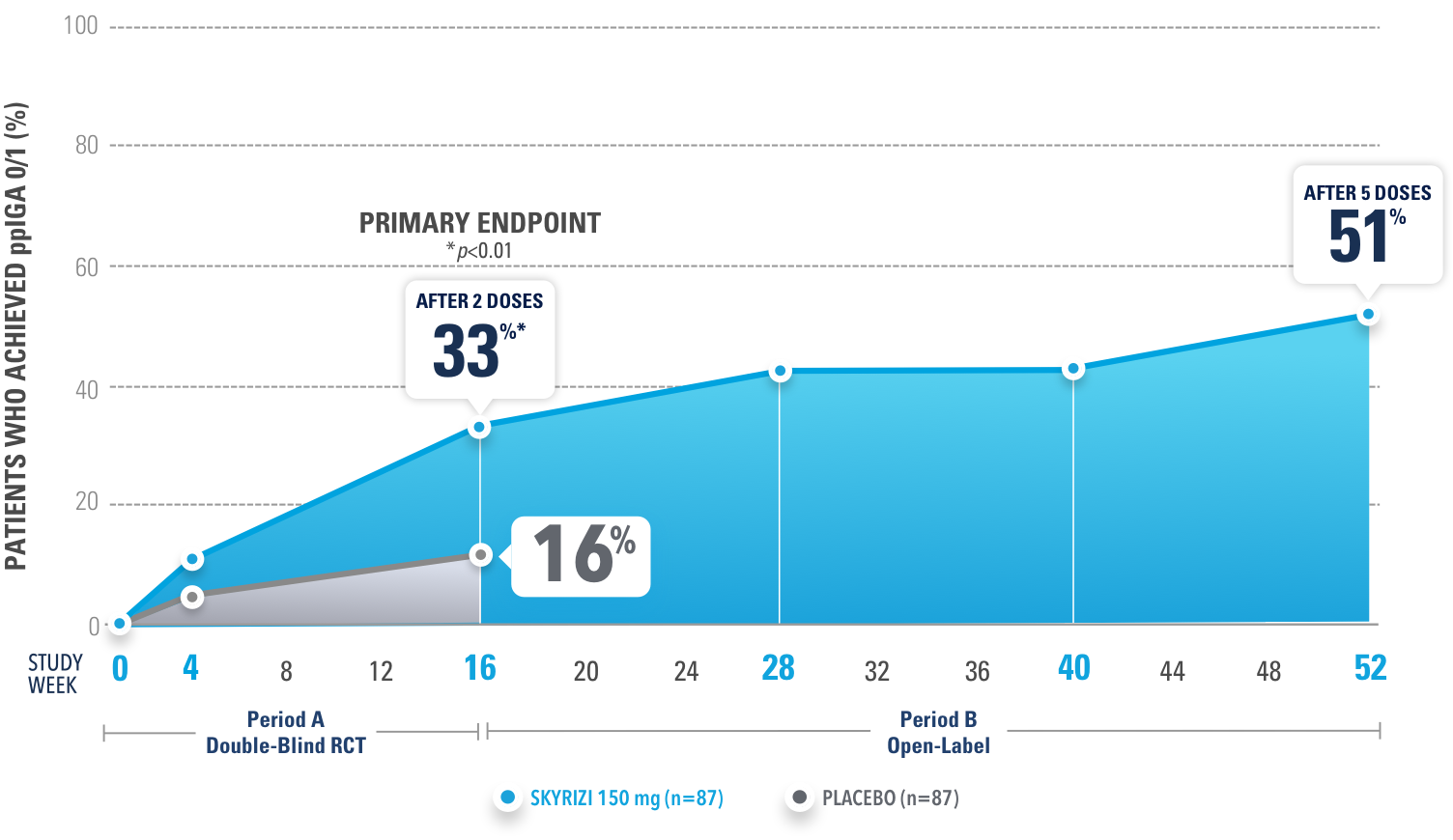
SKYRIZI EFFICACY IN PALMOPLANTAR PSORIASIS5
SKYRIZI MET THE PRIMARY ENDPOINT OF ppIGA 0/1 AT WEEK 16 WITH RESPONSE RATES OBSERVED AT WEEK 525
PERCENTAGE OF PATIENTS ACHIEVING ppIGA 0/1 AT WEEK 16 WITH RESPONSES OBSERVED AT WEEK 52 (NRI-C)
LIMITATIONS:
All endpoints at Week 52 were prespecified, nonranked endpoints and were not controlled for multiple comparisons. Therefore, no statistical or clinical conclusions can be drawn.
OPEN-LABEL (OL) LIMITATIONS:
In an open-label study or period, there is potential for enrichment; awareness of active treatment may cause bias to overall treatment effect.
The ppIGA scale ranges from clear (0) to severe (4) and is based on the modified IGA but specifically applied to the palms and soles.
STUDY DESIGN:
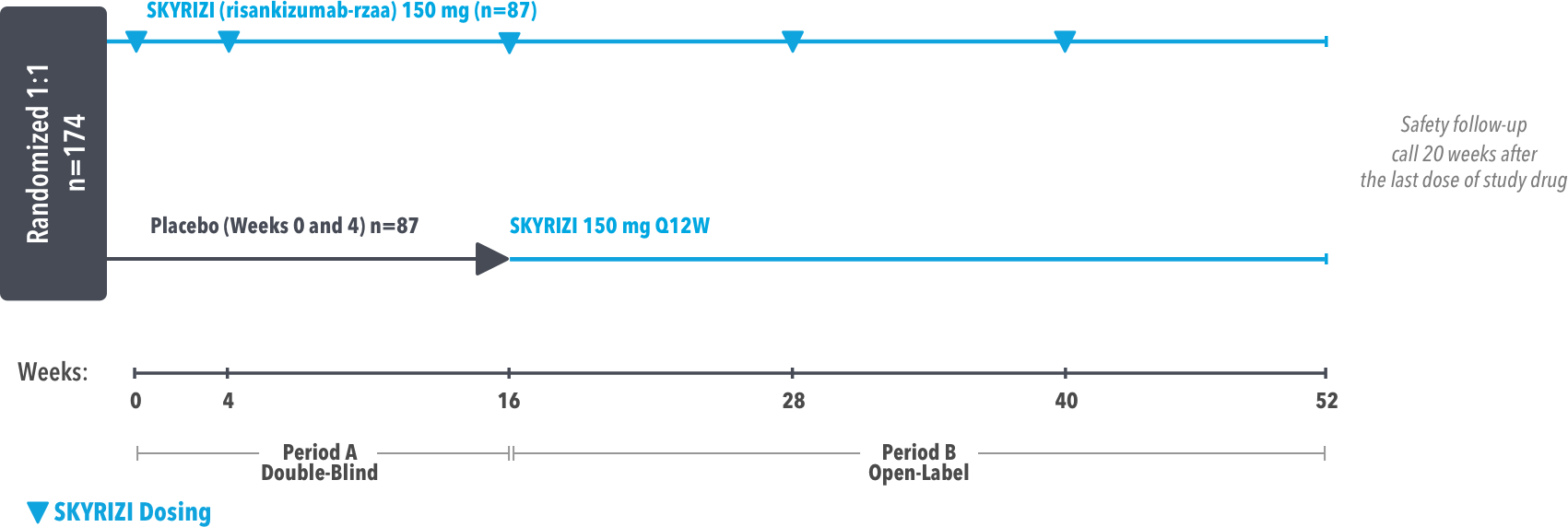
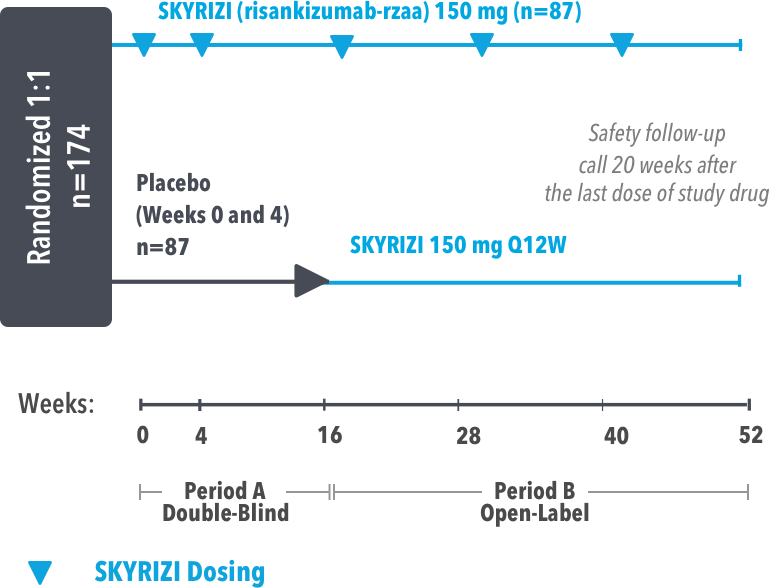
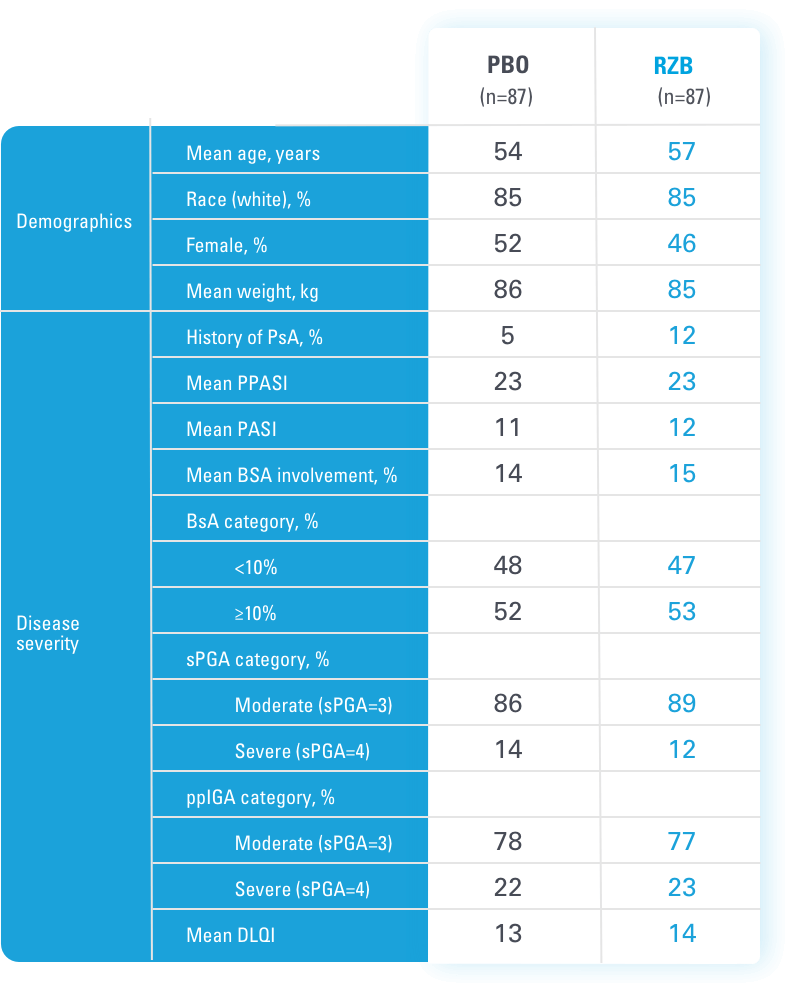
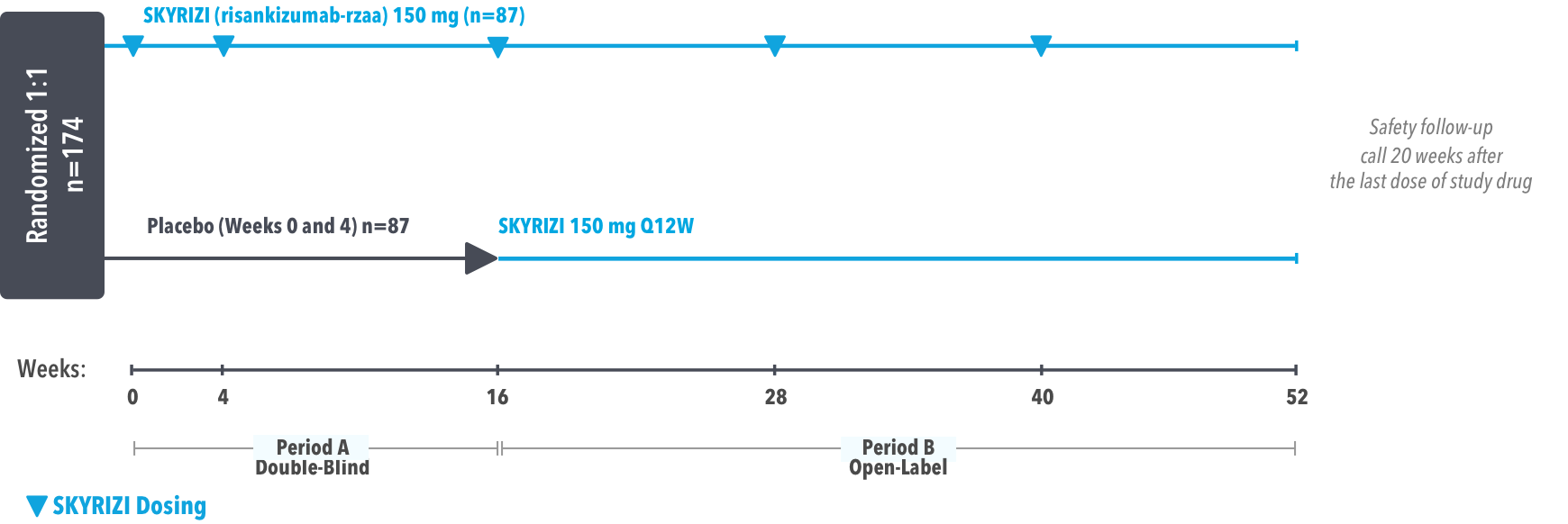
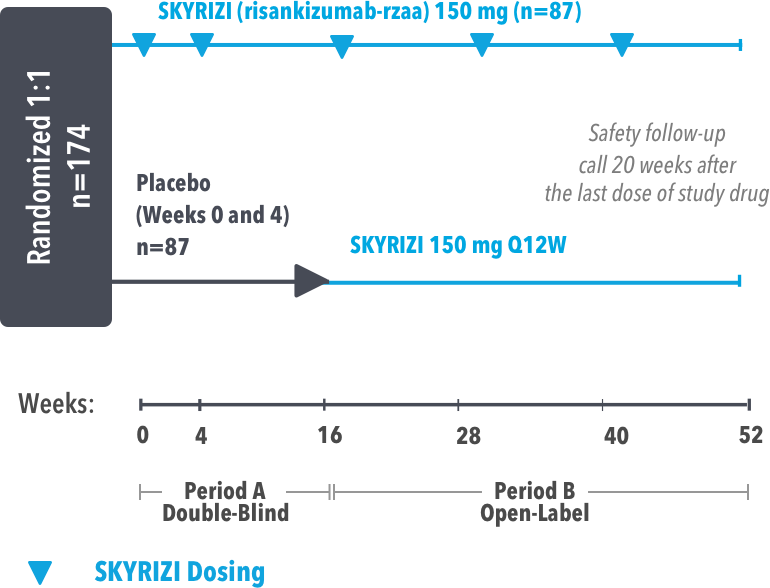
IMMprint was a Phase 3b, multicenter, randomized, double-blind, parallel-group, placebo-controlled, 52-week study that assessed the safety and efficacy of SKYRIZI (150 mg) vs placebo for the treatment of moderate to severe plaque psoriasis in adult patients with palmoplantar (non-pustular) involvement. The primary endpoint evaluated the proportion achieving pplGA of O or 1 with ≥2-point reduction from baseline at Week 16. Additional ranked secondary endpoints included PPASI 75, PPASI 90, sPGA 0/1, and PPASI 100 at Week 16.5
IGA=Investigator's Global Assessment; NRI-C=nonresponder imputation incorporating multiple imputations to handle missing data due to COVID-19; PPASI=Palmoplantar Psoriasis Area and Severity Index; ppIGA=Palmoplantar Psoriasis Investigator's Global Assessment; RCT=randomized controlled trial.

*Ranked secondary endpoint.
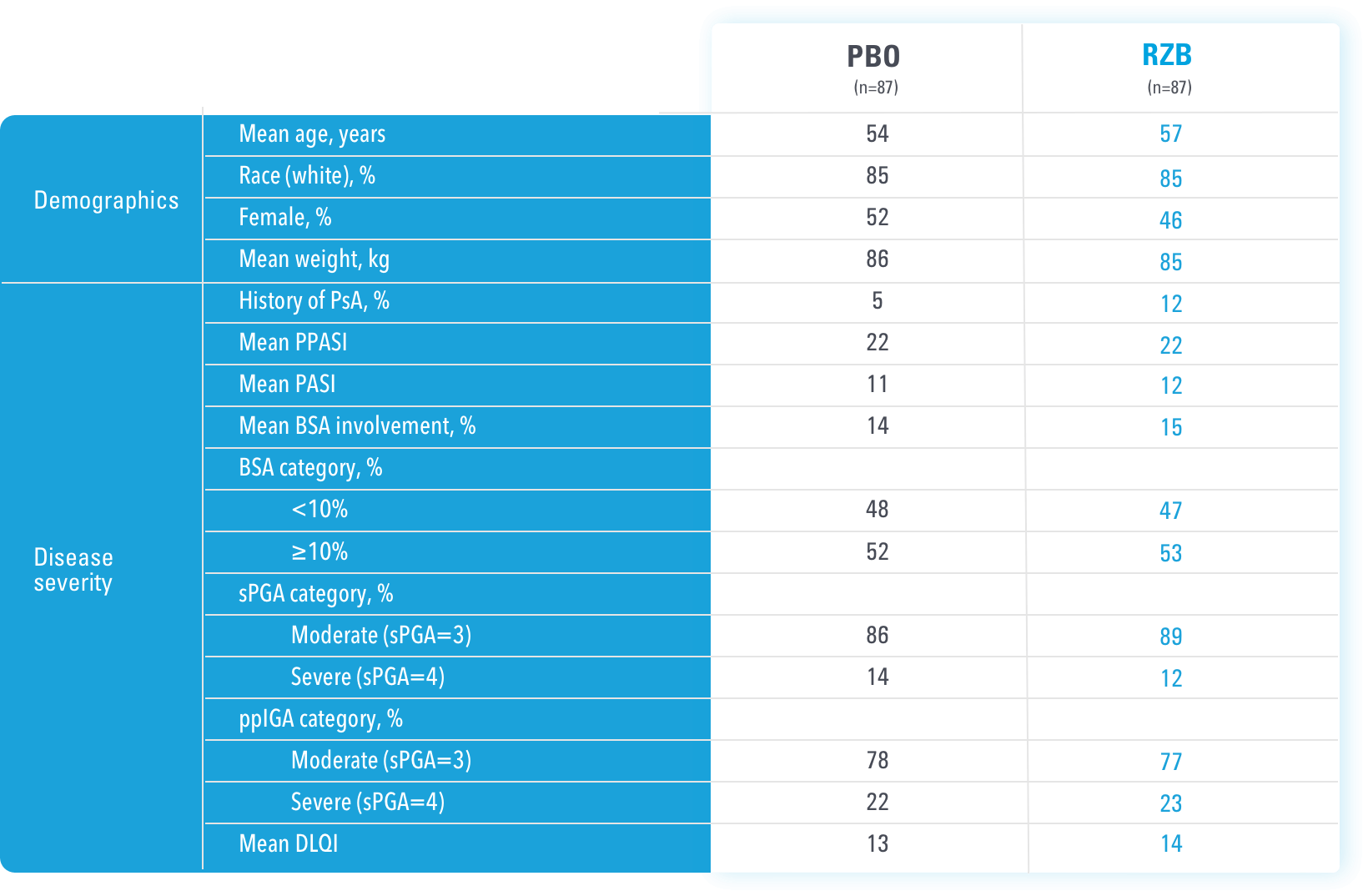
MEAN CHANGE IN PPASI FROM BASELINE (AO)7
AT WEEK 16
PLACEBO 30% (N=81)
MEAN PPASI SCORES AT BASELINE (SD)
SKYRIZI (n=87)
22.5 (13.6)
PLACEBO (n=87)
22.5 (12.1)
LIMITATIONS:
PPASI 75 at Week 52, PPASI 90 at Week 52, and mean change in PPASI were nonranked endpoints and not adjusted for multiplicity. Therefore, treatment differences cannot be regarded as statistically significant.
OPEN-LABEL (OL) LIMITATIONS:
In an open-label study or period, there is potential for enrichment; awareness of active treatment may cause bias to overall treatment effect.
AO DISCLOSURE:
In an as observed analysis (AO) missing visit data was excluded from calculations for that visit, which may increase the percent of responders. All observed data was used regardless of premature discontinuation of study drug, initiation of concomitant medication, or rescue medication. The same patient may not have a response at each timepoint.
STUDY DESIGN:
IMMprint was a Phase 3b, multicenter, randomized, double-blind, parallel-group, placebo-controlled, 52-week study that assessed the safety and efficacy of SKYRIZI (150 mg) vs placebo for the treatment of moderate to severe plaque psoriasis in adult patients with palmoplantar (non-pustular) involvement. The primary endpoint evaluated the proportion achieving pplGA of 0 or 1 with ≥2-point reduction from baseline at Week 16. Additional ranked secondary endpoints included PPASI 75, PPASI 90, sPGA 0/1, and PPASI 100 at Week 16.5
AO=as observed; NRI-C=nonresponder imputation incorporating multiple imputations to handle missing data due to COVID-19; OL=open-label; PPASI=Palmoplantar Psoriasis Area and Severity Index; ppIGA=Palmoplantar Psoriasis Investigator's Global Assessment; SD=standard deviation; sPGA=static Physician's Global Assessment.
SEE ADDITIONAL Ps DATA IN HIGH IMPACT AREAS
FROM A SUBGROUP ANALYSIS OF UltlMMa-1 AND UltlMMa-2 BELOW
In a subgroup analysis of UltlMMa-1 and UltlMMa-2
AT 52 WEEKS, MEAN IMPROVEMENT WAS OBSERVED IN SCALP, NAIL, AND PALMOPLANTAR PSORIASIS6
ON AVERAGE, PATIENTS WITH MODERATE TO SEVERE PLAQUE PSORIASIS EXPERIENCED MEAN IMPROVEMENTS IN SCALP, NAIL, AND PALMOPLANTAR PSORIASIS6
IN AN INTEGRATED SUBANALYSIS OF UltlMMa-1 and UltlMMa-2 AT WEEK 52 (LOCF)

94%
MEAN IMPROVEMENT
IN SCALP PSORIASIS
(MEAN CHANGE IN PSSI FROM BASELINE)
n=528

66%
MEAN IMPROVEMENT IN
NAIL PSORIASIS
(MEAN CHANGE IN NAPSI FROM BASELINE)
n=361
91% MEAN IMPROVEMENT IN PALMOPLANTAR PSORIASIS
(MEAN CHANGE IN PPASI FROM BASELINE) n=184
MEAN PATIENT SCORES AT BASELINE (SD)
PSSI
18.2 (14.7)
PPASI
2.42 (6.0)
NAPSI
13.6 (18.4)
LIMITATIONS:
Mean change in PSSI, PPASI, and NAPSI were prespecified, nonranked endpoints and were not adjusted for multiplicity. Therefore, treatment differences cannot be regarded as statistically significant.
Based on analysis of integrated data from UltIMMa-1 and UltIMMa-2 at Week 52 of patients receiving SKYRIZI who had a baseline score of >0 on NAPSI, PSSI, and PPASI, respectively. Missing NAPSI, PSSI, and PPASI data were imputed as last observation carried forward (LOCF).5
STUDY DESIGN:
UltIMMa-1 (N=506) and UltIMMa-2 (N=491) were replicate Phase 3, randomized, double-blind, placebo- and active-controlled studies to evaluate the efficacy and safety of SKYRIZI (150 mg) vs placebo over 16 weeks and biologic active control (45 mg or 90 mg, based on screening weight) over 52 weeks in adult patients with moderate to severe plaque psoriasis.1,2
LOCF=last observation carried forward; NAPSI=Nail Psoriasis Severity Index; PPASI=Palmoplantar Psoriasis Area and Severity Index; PSSI=Psoriasis Scalp Severity Index; SD=standard deviation.